
Shopping Basket
PM Industry News
EPMA Powder Metallurgy Summer School 2012: Programme now available
The programme for the European Powder Metallurgy Association’s 2012 PM Summer School has be...
» Full storyNew Pometon subsidiary in India
Pometon S.p.A., the Italian producer of ferrous and non-ferrous powders for the PM industry, has ...
» Full storyPowderMet 2012 Nashville: Conference Programme now available
The Metal Powder Industries Federation has published the conference programme for the PowderMet 2...
» Full storySouth Africa’s titanium industry to be worth R5 billion by 2020, with a focus on Ti powder
A report on www.moneyweb.co.za states that South Africa’s titanium industry could be worth ...
» Full story
Articles and Papers
Laser forming of Ti-6Al-7Nb alloy porous parts for medical devices
In the last of our exclusive reports from the international conference on “Powder Processin...
» Full storyEqual Channel Angular Pressing - a cost-effective consolidation route for titanium alloy semi-products?
In the first of a series of exclusive reports for ipmd.net from the international conference on &...
» Full story2011 Hagen Symposium: A review of Spark Plasma Sintering
In his presentation at the Hagen Symposium 2011, which took place in Hagen, Germany, from Novembe...
» Full story2011 Hagen Symposium: An overview of Powder Metallurgy sintering furnaces
The technology of sintering in protective gas atmospheres was the subject of a review by Prof Pau...
» Full story
Designing for Powder Metallurgy
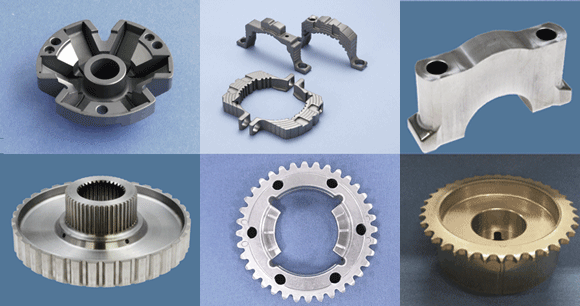
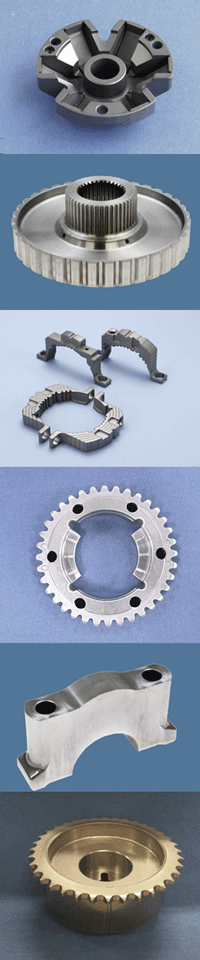
A selection of JPMA award winning
PM components that show the
designs that are possible when
using press/sinter Powder
Metallurgy. For more information
on each part visit our awards
pages (Photos courtesy
JPMA)
Although Powder Metallurgy technology offers considerable design freedoms, there are a number of “dos and don’ts” to be borne in mind when designing a product with the process in mind.
These are highlighted in the following guidelines:-
- Aspect ratio
The aspect ratio (i.e. length to width ratio) – the density variations created by friction effects between the powder feedstock and the tooling mean that, even with double-ended compaction, aspect ratio should be limited to no more than 3:1.
- Re-entrant features
Re-entrant features such as grooves, reverse tapers or lateral holes, cannot be directly formed by Powder Metallurgy as they would prevent the part from being ejected from the die. If needed, such features would have to be introduced by machining of the sintered part.
- Bevels
Bevels would require feather-edged punches, which should be avoided. If possible, a bevelled edge should end in a small flat, thus avoiding the feather edge.
- Chamfers
Chamfers are preferred to radii on component edges, again to avoid the need for feather-edged punches
- Abrupt changes in section
Abrupt changes in section should be avoided as they introduce stress raisers that can lead to cracking due to springback in ejection.
- Sharp corners
Radii rather than sharp corners in the plan view section should be incorporated, again to avoid stress raisers.