
Forming a Powder Metallurgy compact
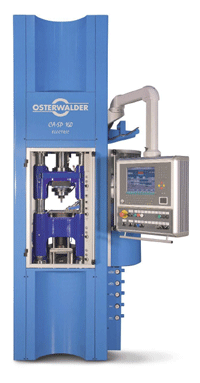
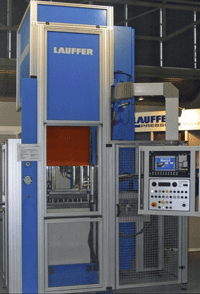
The dominant technology for the forming of products from powder materials, in terms of both tonnage quantities and numbers of parts produced, is Die Pressing. This forming technology involves a production cycle comprising:
- Filling a die cavity with a known volume of the powder feedstock, delivered from a fill shoe
- Compaction of the powder within the die with punches to form the compact. Generally, compaction pressure is applied through punches from both ends of the toolset in order to reduce the level of density gradient within the compact.
- Ejection of the compact from the die, using the lower punch(es)
- Removal of the compact from the upper face of the die using the fill shoe in the fill stage of the next cycle.
This cycle offers a readily automated and high production rate process. There are, however, some limitations to the products delivered by this route:
Geometrical complexity
The geometrical complexity that can be delivered might best be described as “two and half dimensional”. There is unlimited complexity in the radial directions (i.e. in the plan view of the part); if the shape can be cut into the die, then it can be formed in the part. In the third dimension, the axial or through-thickness direction of the part, there are, however, significant limitations.
Changes in section thickness can be created by the use of multiple top and bottom punches and holes in this direction can be created through the incorporation of core rods and mandrels in the toolset. However, re-entrant features cannot be formed as they would impede ejection of the part from the die.
Aspect ratio
The aspect (length to diameter) ratio of the part is limited (to around 3:1) if acceptable control over density variations is sought.
Size and weight
The size and weight of the part is limited by the maximum tonnage capacity of available forming presses (around 1000 tonnes capacity). A 2 kg. ferrous PM part would be regarded as being a large one.
Strength
The strength level of conventionally die pressed parts is limited to some degree by the influence of the remaining porosity in the product. A range of process developments have been introduced, many of them evolutions of the standard press/sinter process, which have tackled this particular issue.
A number of alternative forming processes have been developed, which have sought to attack one or more of these limitations.
Isostatic pressing
Isostatic pressing can tackle all four limitations in that very large components can be formed, the only limit on achievable aspect ratio arises from the dimensions of the vessel containing the pressing fluid, true three-dimensional geometrical complexity can be achieved and full-density compaction can be delivered. All this is, however, at the expense of significant increases in forming cycle time and some limitations in dimensional tolerance control, compared with die pressing.
In isostatic pressing, the powder is compacted with a hydrostatic pressure in all directions. The process can be carried out cold or hot.
Cold isostatic pressing (CIP)
In cold isostatic pressing, the powder is contained in a flexible mould, commonly of polyurethane, which is immersed in liquid, usually water, in a pressure vessel, which is pumped to high pressure.
Hot isostatic pressing (HIP)
In hot isostatic pressing, the pressuring medium is a gas, normally argon. The powder is contained in a metallic can, which is subjected to the hydrostatic pressure in the pressure vessel. Full density is achievable by HIP and the process is used for superalloys, high speed steels, titanium etc. where integrity of the materials is a prime consideration.
A significant contributor to HIP costs arises from the canning process. So, there is significant interest in “canless HIP” processing. If the powder can be consolidated to a density above about 92% by a preliminary forming process (e.g. die pressing or CIP), surface connected porosity can be eliminated, gas penetration into the part can be avoided during the subsequent HIP process and full densification can be achieved.
A variant of this approach is Sinter-HIP, in which the required 92%+ density is achieved by sintering and then HIP consolidation is applied in the same vessel.
Split die compaction
An early process development aimed at enhancing geometrical complexity of PM parts and introducing the capability for forming re-entrant features was an evolutionary extension of die pressing, known as split die compaction. In this process, the toolset was engineered so that, after the part was formed, the die could be parted in the horizontal plane, allowing the compact with the re-entrant features to be ejected between the two halves of the die.
Metal Injection Moulding
However, the process that has had the major impact in extending shape capability of parts made from powders has been Metal Injection Moulding (MIM). In MIM, the powder is mixed with an organic binder to create a feedstock, which can be injected into a mould in a manner identical to the process used for injection moulded plastic parts. After release of the green body from the mould, it is debound and then sintered.
Close dimensional tolerances can be held in this process and, because of the fine powders used and consequent high sintering activity, density levels close to full density and therefore high strength levels can be achieved. Also, extremely complex 3-dimensional geometries can be formed. However, principally because of the difficulties involved with the debinding stage of the process, MIM parts are generally small and light with thin-walled sections. As a comparison with die-pressed parts, a 100 g. MIM part would be considered large.
A complete introduction to the Metal Injection Moulding process is available on www.pim-international.com
Next page: Sintering | Return to contents page
Download PM Review magazine