
Why Powder Metallurgy?
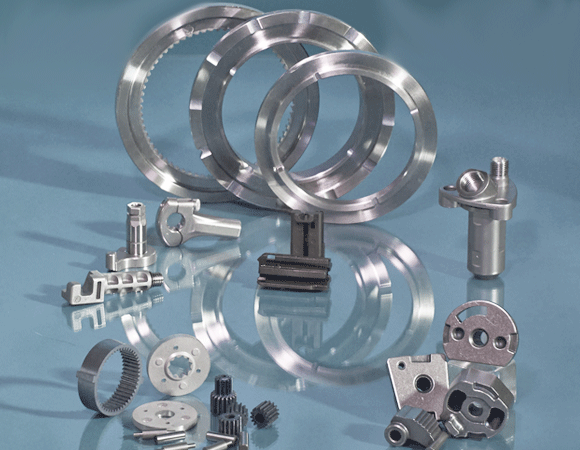
Powder Metallurgy is a technology which involves spending considerable time and effort in converting the starting material to the required powder form and then even further time and effort in “sticking” the material back together again to produce a more or less solid object.
On describing the technology in these terms, it is not unreasonable therefore to pose the question “Why go to all this effort?”
There are, in fact, many good reasons why Powder Metallurgy might be chosen as the preferred route for the manufacture of a product. In broad terms, these reasons separate into two categories:
- Cost effectiveness
Powder Metallurgy is the most cost effective of a number of possible options for making the part - Uniqueness
Some characteristic of the product (e.g. combination of chemical constituents, control over microstructure, control over porosity etc.) can be created by starting from a powder feedstock, which would be very difficult or sometimes impossible in conventional processing
Cost effectiveness
Product cost effectiveness is by far the predominant reason for choosing Powder Metallurgy and is the main driver of the structural (or mechanical) parts sector. Powder Metallurgy wins the cost competition on the basis of its lower energy consumption, higher material utilisation and reduced numbers of process steps, in comparison with other production technologies.
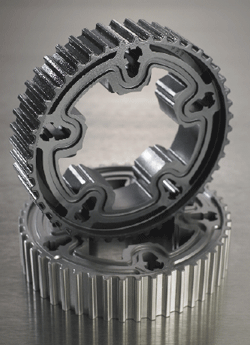
All of these factors, in turn, are dependent on Powder Metallurgy’s ability to reduce, or even possibly eliminate entirely, the machining operations that would be applied in conventional manufacture.
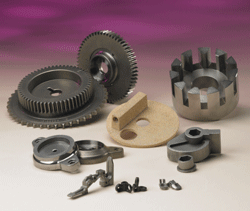
In order to eliminate machining operations, Powder Metallurgy relies on its abilities to form complex geometrical shapes directly and to hold close dimensional tolerance control in the sintered product.
Powder Metallurgy’s cost effectiveness generally also requires that the particular product be made in large production quantities. If production quantity requirements are too low, there would be no opportunity to amortise the costs of the (long-lasting) forming tooling over a sufficient numbers of parts or to avoid the loss of significant fractions of potential production time in tool changeover/setting operations.
The production quantities at which Powder Metallurgy would be the process of choice is of course dependent on how difficult it would be to form the shape by a different route, but, in general, would be at least in the order of tens of thousands of parts per year.
Uniqueness
Product uniqueness can be delivered by Powder Metallurgy in a number of different ways:
1. Processing combinations of materials that would otherwise be impossible to mix
Powder Metallurgy allows the processing, in an intimate mixed form, of combinations of materials that would be conventionally regarded as immiscible. Well-established examples of this type of Powder Metallurgy application are:
- Friction materials for brake linings and clutch facings in which a range of non-metallic materials, to impart wear resistance or to control friction levels, are embedded in a copper-based or iron-based matrix.
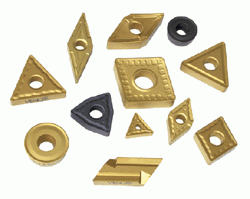
- Hardmetals or cemented carbides, used for cutting tools, forming tools or wear parts. These comprise a hard phase bonded with a metallic phase, a microstructure that can only be generated through liquid phase sintering at a temperature above the melting point of the binder. Tungsten carbide bonded with cobalt is the predominant example of such a material, but other hardmetals are available that include a range of other carbides, nitrides, carbonitrides or oxides and metals other than cobalt can be used as the binder (Ni, Ni-Cr, Ni-Co etc.)
- Diamond cutting tool materials, in which fine diamond grit is uniformly dispersed in a metallic matrix. Again, liquid phase sintering is employed in the processing of these materials.
- Electrical contact materials e.g. copper/tungsten, silver/cadmium oxide.
2. Processing of materials with very high melting points
Powder Metallurgy enables the processing of materials with very high melting points, including refractory metals such as tungsten, molybdenum and tantalum. Such metals are very difficult to produce by melting and casting and are often very brittle in the cast state. The production of tungsten billet, for subsequent drawing to wire for incandescent lamps, was one of Powder Metallurgy’s very early application areas.
3. Products with controlled levels of porosity
Powder Metallurgy enables the manufacture of products with controlled levels of porosity in their structure. Sintered filter elements are examples of such an application. The other prime example is the oil-retaining or self-lubricating bearing, one of Powder Metallurgy’s longest established applications, in which the interconnected porosity in the sintered structure is used to hold a reservoir of oil.
4. Products with superior properties
In some specific applications, the generation of superior properties, often through superior control over microstructure, is possible by Powder Metallurgy processing as opposed to conventional casting or wrought routes. Good examples in this category of application are:
- Magnetic materials
Virtually all hard (permanent) magnets and around 30% of soft magnets are processed from powder feedstocks. - High speed steels
The finer and more controlled microstructure from a Powder Metallurgy processed material provides superior toughness and cutting performance than wrought products. - Nickel- or cobalt-based superalloys
Nickel- or cobalt-based superalloys are used for aero-engine applications, in which Powder Metallurgy processing can deliver compositional ranges and microstructural control not achievable conventionally and therefore an enhancement in operating temperature and performance.
Next page: Markets for PM components | Contents page
Download PM Review magazine