
JPMA Award Winners 2010
The winners of the Japan Powder Metallurgy Association (JPMA) 2010 Powder Metallurgy Awards highlight the capabilities of PM and demonstrate the continuing advances of Japan’s PM industry. Many of the winners are evidence of the continuing potential for PM applications in the automotive industry.
< See award archive
Development Prize – New Design
Sintered Preform for Engine Block
Nippon Piston Ring Co., Ltd
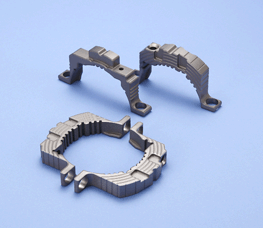 Nippon Piston Ring Co., Ltd, received an award in this category for a sintered preform, which is then cast into the crank journal portion of an automobile aluminium engine block.
This iron based sintered component has high rigidity with low linear expansion and enhances the strength of the journal portion of the engine block. The part suppresses any increase of gap between the crank shaft and the aluminium block caused by the difference in thermal expansion due to the heat generated during operation of the engine. Vibration and noise are prevented from occurring.
The component is made from an iron-copper-carbon material with high copper content for enhancing the adhesion to the aluminium alloy. Surface treatment (blasting) performed on the component provides a stable bonding strength and adhesion at the interface.
Compared to the conventional production processes, involving a metal matrix composite (MMC) preform and further post-processing, costs are reduced by 40%.
Forward Clutch Hub
Sumitomo Electric Industries, Ltd.
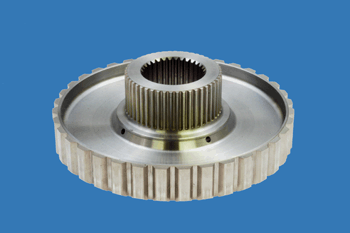 Sumitomo Electric Industries, Ltd. (SEI) developed this Forward Clutch Hub, a torque transmission part for forward and backward movement in a chain type Continuously Variable Transmission (CVT). The component has complicated features such as a large thin rim with long outer spline and a long boss with inner and outer splines.
The market for automobile CVT’s has been expanding due to the growing demand for smaller engines and lower fuel consumption. Until now the only PM components used in a CVT system were for the oil pump, however this new product now offers more opportunities for the PM industry.
The use of the PM process allowed SEI to achieve lower production costs and a higher strength partly due to the use of a Ni-free high strength powder resulting in superior machinability. The production process involves multi level compaction with three upper and four lower punches on a CNC press.
Electromagnetic Continuous Cam part
Diamet Corporation
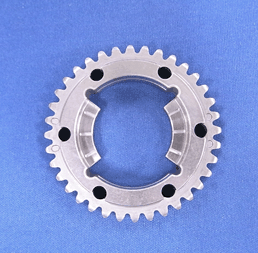 An award was given to Diamet Corporation for this component used in an electromagnetic continuous cam phase variation mechanism.
The mechanism achieves a wide control range and fast response that can’t be achieved with conventional hydraulic systems. High torque can be obtained from a slow revolution speed, which allows smooth acceleration and deceleration. The product not only provides better performance in demanding driving conditions, but also achieves cleaner emissions and much higher fuel efficiency.
The high density of 7.2 g/cm3 is achieved by room temperature compaction by using a newly developed lubricant. Pre-alloyed Fe-Mo powder is used and the hardness of 45 HRC is attained by optimised heat treatment.
In order to minimize dimensional change during sintering, density deviation of the product is controlled within 0.05 g/cm3 by optimising press motion and powder filling methods.
Governor part for a motorbike starter clutch
Hitachi Chemical Co., Ltd.
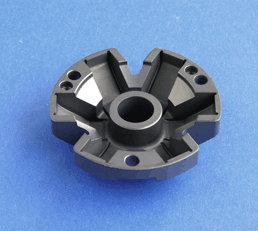 The Powder Metal Products Business Sector – Automotive Products Business of Hitachi Chemical Co., Ltd. also received a prize for the development of this governor part for a starter clutch used in a variable hydraulic transmission system for motorcycles.
Until now, the combination of a belt type continuously variable transmission (CVT) and automatic centrifugal clutch has been the main system used for the continuously variable transmission of motorcycles. A new clutch system, with an infinitely variable hydraulic transmission and new hydraulic system, was developed to improve the transmission efficiency.
The part is a complicated shape incorporating a wear resistant taper face, allowing the clutch to adjust the opening of the clutch-valve depending on engine speed. Although carburizing heat treatment is a common method of increasing wear resistance, it was difficult for this part because of the requirement of high dimensional accuracy on the rolling faces. As the part is used in oil, a steam treated Fe-Cu-C material was used, allowing for good oil retention and a high hardness.
Sintered VVT parts
Diamet Corporation
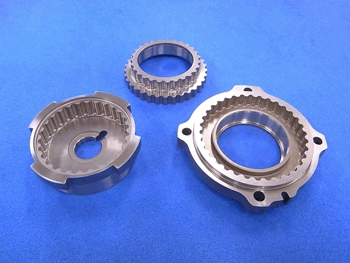 A second prize for Diamet Corporation was given for their development of three components used in an electric variable valve timing control system.
The products require high precision and wear resistance to satisfy the deceleration control of the camshaft revolution speed. The alloying system is high strength Fe-Ni-Cu-Mo-C material, and heat treatment is conducted for wear resistance.
During compaction, density deviation of the parts is controlled to less than 0.05g/cm3 by optimising powder filling, die and punch motion and punch distortion. Sintering and heat treatment processes are optimised to achieve both high precision and hardness.
Parts for a gasoline engine decompression system
Diamet Corporation
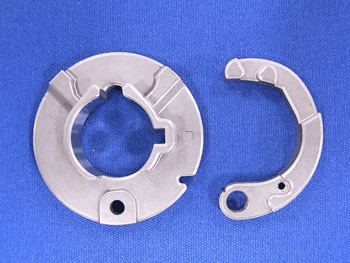 These two award winning components were developed by Diamet Corporation for the decompression system of a gasoline engine. The system, which decompresses the combustion chamber, allows the piston to move from top dead centre to its downstroke smoothly.
Diamet optimised the design of the part to prevent sticking issues during ejection of the compact. The design also allowed for uniform density to be achieved. Optimisation of tooling geometry, by calculating deflection of lower punches and powder filling, was undertaken in order to control any height deviation of the five boss parts.
The sintered products are 20% lighter than existing parts made using the lost wax investment casting process, the PM process not only provides a weight reduction but also allows significant cost savings.
Combined sprocket with weight balancer
Diamet Corporation
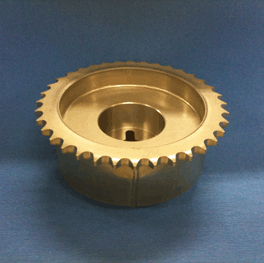 Cars with variable valve timing (VVT) systems are becoming popular as they offer improved fuel efficiency and help reduce emission levels.
Diamet Corporation has designed this combined sprocket with weight balancer for the replacement of thin sprocket parts and massive weight balancers causing unbalanced geometries.
Tooling geometry and material are optimised to reduce deflection of the lower punch, preventing damage of the thin lower punch by lateral pressure from the weight balance part. A high compressibility iron powder, newly developed high performance lubricant, and a cooling and lubricating system for tooling is used.
Light weight automotive bearing caps
Sumitomo Electric Industries, Ltd.
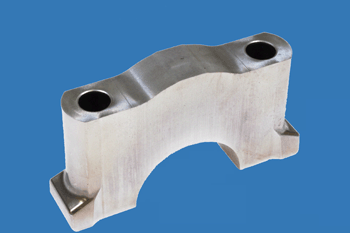 A second price in this category for Sumitomo Electric Industries, Ltd (SEI), was given for light weight bearing caps, which hold the crankshaft in the cylinder block of an automobile engine.
Conventional bearing caps are made from the machining of cast iron, which is costly to produce if high accuracy is required. Recently, due to the demand of good fuel consumption, additional machining operations have been required to remove excess material.
Newly developed PM bearing caps now offer a low cost and light weight option, without the need for costly machining. Excess material is removed by shoulder die compacting, and the snap width accuracy is assured by a sizing process, which eliminates the machining process. Powder metallurgy also allows a 14% weight reduction to be achieved.
Development Prize – New Materials
Fe-Cu based oil-impregnated bearing material
Diamet Corporation
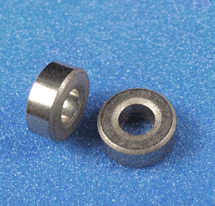 In the New Materials category Diamet Corporation received an award for their Fe-Cu based oil-impregnated bearing material, developed for use in electric actuator motors placed around automotive engines.
With the move to lower emissions and lower fuel consumption, the application of electric actuators, such as electronic throttle and exhaust gas recirculation systems, has been increasing. Although ball bearings are usually used for electric actuators around automotive engines, the development of a material with heat resistance and high durability can replace ball bearings with oil-impregnated ones.
Diamet state that there are two important areas in this development. The first is the production of heat resistant oil (up to 150°C) by the addition of an optimised resin as a solid lubricant. The second is controlled microstructure by using a special copper powder. The microstructure consists of an adaptable surface with copper ratio above 80% and a high strength lining area with copper ratio below 50%. As a result, the newly developed material shows excellent adaptability and wear resistance at high temperatures
New material for long service life oil impregnated sintered bearings in high load, low speed applications
Porite Corporation
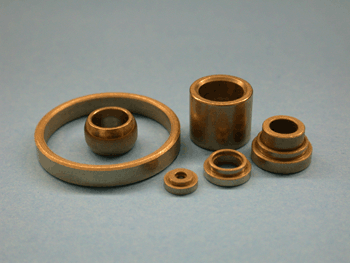 A prize was presented to Porite Corporation for the development of a new material used for long life oil impregnated sintered bearings in high load, low speed applications.
Copper based oil-impregnated sintered bearings are mainly used in these applications today, but the improvement of further wear resistance and a longer life is often desired.
This new material provides an improvement of matrix strength using a special compound consisting mainly of copper coating iron powder. A solid lubricant allows graphite to be dispersed uniformly in a large quantity. With a high content of graphite, even at high load, low speed conditions, the lubricant characteristics are good.
When compared to the conventional copper-tin-graphite made material, wear resistance is tripled by the iron foundation effect. The matrix strength provides high porosity and a good combination with lubricant oil improves the life of the component by five times. Material cost is also reduced 20%.
Heat and wear resistance material for high temperature engine parts
Hitachi Chemical Co., Ltd.
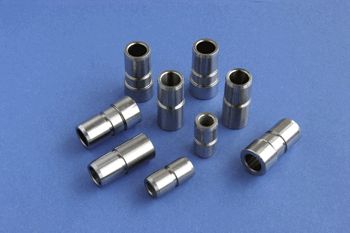 The development of a material with excellent heat and wear resistance, suitable for high temperature engine parts, also gave Hitachi Chemical Co., Ltd. a prize in the New Materials category.
Demand for devices such as turbochargers and exhaust gas recirculation (EGR) systems, to provide higher performance and better fuel consumption, has been increasing in recent years.
Generally, sintered materials tend to have inferior heat resistance compared with wrought materials due to pores in the material. However, Hitachi state that their new material, developed by utilizing several techniques, produced a sintered material that has superior heat and wear resistance to that of wrought materials.
The new material is composed of Fe-Cr-Mo-Si-P-C and has a large content Cr (34%). A higher density is achieved due to liquid sintering via adding P, the material therefore prevents the disadvantages of pores. The material was confirmed to have better heat and wear resistance than high Cr wrought cast iron, which is a popular material for the requirements in the market. The material has already been used for bushings in turbochargers and EGR systems.
Development Prize – Process Development
MIM Automotive Turbocharger Vane
Fine Sinter Co., Ltd.
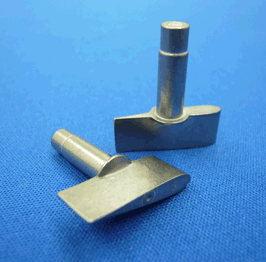 The only award in the Process Development category was presented to Fine Sinter Co., Ltd., for their metal injection moulded (MIM) variable nozzle vane designed for a diesel turbocharger.
The manufacturing method uses a special tool that has a unique sliding function when opening, reducing deformation during ejection. The part meets strict dimensional tolerance requirements, as close as ±0.015mm on the wing profile, which were achieved with additional machining.
By using the MIM process, Fine Sinter has reduced the production costs by approximately 20%.
Effort Prize
Ni-free high strength sinter hardening material
Hitachi Chemical Co., Ltd.
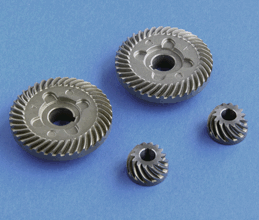 The JPMA awarded an Effort Prize to Hitachi Chemical Co. Ltd., for a new Ni-free, high strength, sinter hardening material.
Generally, sintered machine parts are quenched and tempered after sintering to improve mechanical properties. However, conventional high strength sintered materials usually contain Ni, a powder that is of relatively high cost and unstable supply.
Hitachi have developed a Ni-free high strength sintered material without the need for a quenching process. The alloy design is based on a Cr-Mo pre-alloyed powder, with a small amount of Cu in order to improve the hardenability. Hitachi state that the new material, with appropriate graphite, can obtain a 90%+ martensite structure. It results in a high strength and high toughness greater than those of a carburised, quenched and tempered 4% Ni based sintered material.
Induction hardening process for the narrow groove of a VVT rotor
Sumitomo Electric Industries, Ltd.
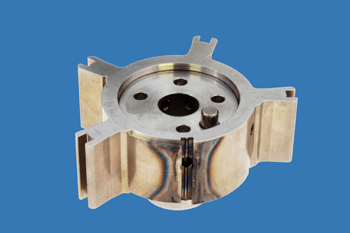 Sumitomo Electric Industries, Ltd., won an Effort Prize for their development of an induction hardening process for the narrow groove of a rotor used in a variable valve timing (VVT) system.
Wear resistance is required at the narrow groove on the outer diameter of a VVT rotor component as a stopper plate will be sliding along this groove. The induction hardening method is widely utilised in powder metallurgy products as a partial hardening method, however in this case there was thermal strain, dimensional problems and melting at the groove edge.
Sumitomo state that successful hardening of the area was obtained without material melting by decreasing frequency and increasing current penetration depth by almost double. However the coil life became much shorter because high voltage and current are required for sufficient heating in the narrow groove. Higher voltage and current could be decreased by shifting the direction of the magnetic field by attaching a ferritic core to the coil. A further single coil is installed to decrease thermal strain and a positioning mechanism between the component and coil with 0.01mm range was used.
Parts for an electric vacuum pump designed for an electric vehicle brake assist system
Sumitomo Electric Industries, Ltd.
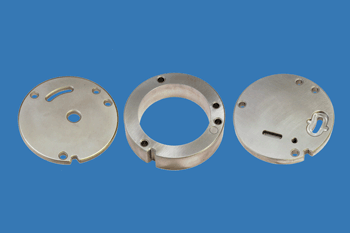 A second Effort Prize was given to Sumitomo Electric Industries, Ltd., for their development of parts for an electric vacuum pump designed for the brake assist of electric vehicles (EV).
For gasoline engine vehicles braking force is assisted by using negative pressure obtained by the engine, but for EV’s negative pressure is obtained by an electric vacuum pump as there is no engine. This electric vacuum pump is a vane type pump without lubricant. Rotor and vanes are made of graphite, and ring and plate are made of sintered stainless steel. Corrosion-resistance at the bottom of the body and air tightness against leakage is required.
Resin impregnation and shot blasting are conducted for air tightness after compacting and sintering. Dimensional variation and warp is improved by the minimising of density variation and optimising the sintering conditions.
For more information please visit the JPMA website