
Properties of Powder Metallurgy materials
Mechanical properties of structural Powder Metallurgy components
The mechanical properties available from the materials, commonly used for structural or engineering component applications, can be summarised as follows:
Ferrous Powder Metallurgy materials
Ferrous Powder Metallurgy materials, processed by the standard die press and sinter route, can deliver UTS levels up to around 900 N/mm² in the as-sintered condition or up to around 1200 N/mm² after heat treatment or sinter hardening.
These pressed and sintered materials can also deliver tensile yield stress levels up to around 480 N/mm2 as-sintered or around 1200 N/mm² after heat treatment or sinter hardening. Compressive yield stresses are slightly higher at up to around 510 N/mm² as sintered or up to around 1250 N/mm² heat treated.
These very significant levels of strength are, however, accompanied by quite low levels of tensile ductility (Elongation levels below 2% being quite typical). For this reason, PM products at conventional press/sinter density levels (up to 7.1-7.2 g/cm³ maximum) would not be used in applications likely to experience gross plasticity in service.
Powder forged steels
Powder forged steels can deliver high strength levels (UTS up to around 950 N/mm² as forged and 2050 N/mm² heat treated; tensile yield stress up to around 650 N/mm² as forged and 1760 N/mm² heat treated) with higher levels of ductility (5-18% Elongation).
Stainless steels
300 series PM stainless steels, in the Press/Sinter condition, can deliver UTS levels up to around 480 N/mm², tensile yield stress up to around 310 N/mm² and compressive yield strength up to around 320 N/mm², but with much higher ductility levels than their low alloy steel counterparts. (>10% Elongation).
400 series PM stainless steels can deliver similar properties to the 300 series materials in the as-sintered condition. Heat treatment of martensitic grades can increase strength levels to up to around 720 N/mm² UTS and tensile yield stress and 640 N/mm² compressive yield stress, but at the expense of a much reduced ductility (<1% Elongation).
Copper alloys
Press and sintered Cu alloys can deliver relatively modest strength levels (up to around 240 N/mm² UTS, 140 N/mm² tensile yield stress and 170 N/mm² compressive yield stress) but with much higher ductility than their ferrous counterparts (10-20% Elongation).
Aluminium alloys
Pressed and sintered Al alloys can deliver UTS of up to around 200 N/mm2 as sintered or up to around 320 N/mm² after heat treatment and tensile yield stress of up to around 170 N/mm² as sintered or up to around 320 N/mm² after heat treatment, but with quite low ductility levels (0.5-2% Elongation).
Fatigue strength
Both Press/Sinter Powder Metallurgy steels and Powder Forged steels are capable of providing significant levels of fatigue strength:
- In the as-sintered condition, Press/Sinter PM steels can deliver fatigue endurance limits of up to around 320 N/mm² in the rotating bend loading mode and up to around 270 N/mm² in the axial loading mode (R = -1, Kt = 1).
- Heat treatment can raise these values to up to around 540 N/mm² and 460 N/mm² respectively.
- Powder forged steels can deliver fatigue endurance limits of up to around 420 N/mm² in the rotating bend loading mode and up to around 360 N/mm² in the axial loading mode (R = -1, Kt = 1).
- Heat treatment can raise these values to up to around 635 N/mm2 and 560 N/mm² respectively.
Global Powder Metallurgy Property Database
Design Engineers and other material specifiers in organisations that are customers or potential customers for Powder Metallurgy components, ought to be aware of the Global Powder Metallurgy Property Database.
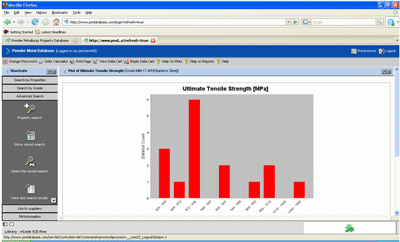
This database is a very significant resource for anyone assessing the capabilities of Powder Metallurgy for target applications and holds verified and accredited mechanical, fatigue and physical properties across a number of material categories:
- Powder Metallurgy low alloy steels
- Stainless steels
- Non-ferrous structural part materials
- Powder Forging steels
- Powder Metallurgy self-lubricating bearing alloys
- Metal Injection Moulding alloys – ferrous and non-ferrous
Full fatigue SN-curve information is also downloadable, in pdf format, for a range of Fe-Cu-C PM structural part grades, tested under a range of fatigue conditions.
Next page: Powder Metallurgy standards | Contents page
Download PM Review magazine